NorrChemica™
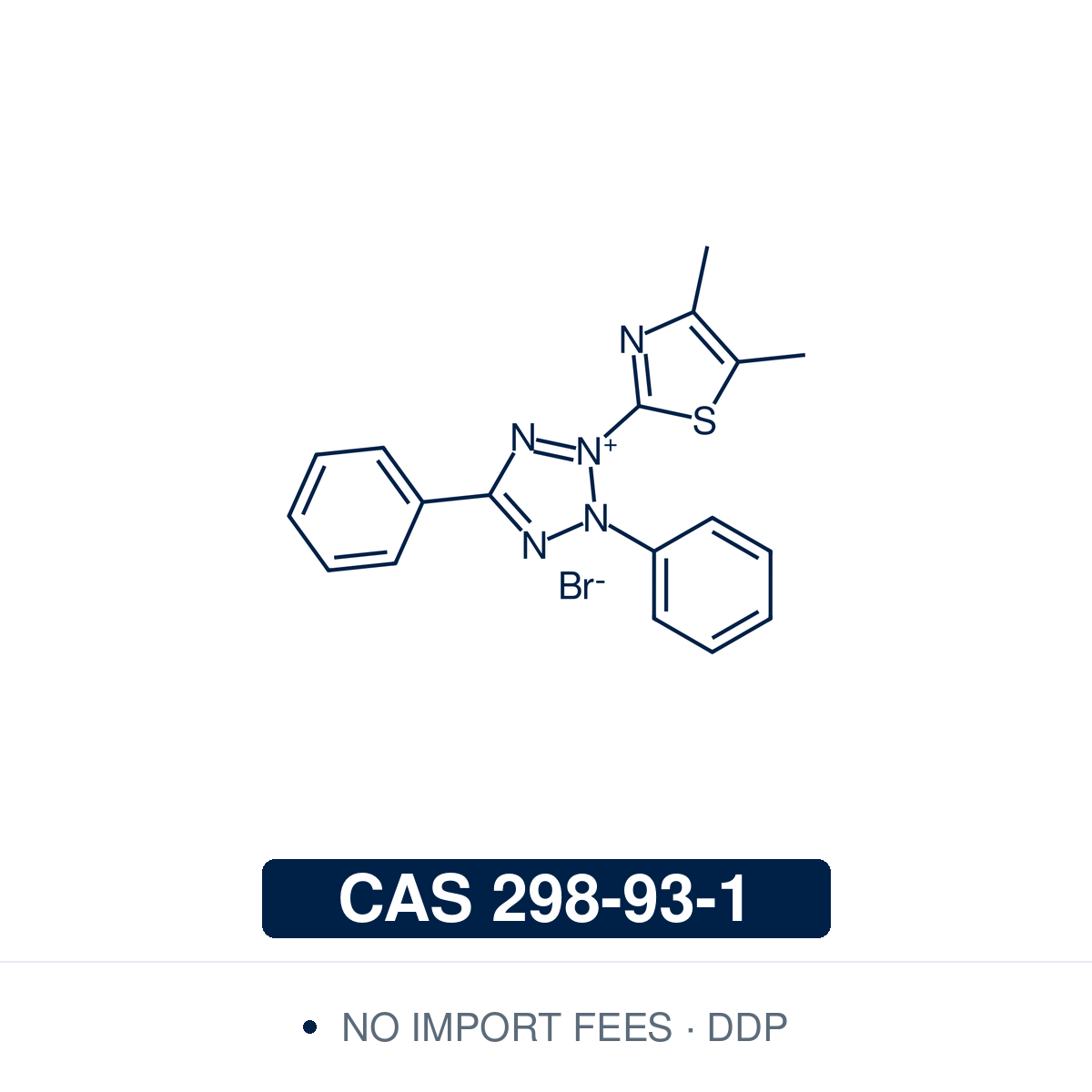
Thiazolyl Blue Tetrazolium Bromide (MTT)
Thiazolyl Blue Tetrazolium Bromide (MTT) | CAS 298-93-1 | ≥98%
| Pack size | Excl. VAT | Incl. VAT | Add to cart |
|---|---|---|---|
| 250 mg | €49,20 | ||
| 1.0 g | €79,20 | ||
| 5.0 g | €149,20 | ||
| 25 g | €489,20 | ||
| 100 g | €1.435,00 |
Taxes and fees, e.g. VAT, included in the price. Shipping calculated at checkout.Free shipping on EU, UK and EFTA orders above €250, and above €400 to the rest of the world.
Technical Specifications
| CAS Number | 298-93-1 |
| EC / EINECS Number | 206-069-5 |
| MDL Number | MFCD00011964 |
| RTECS Number | XF8060000 |
| SMILES | CC1=C(SC(=N1)[N+]2=NC(=NN2C3=CC=CC=C3)C4=CC=CC=C4)C.[Br-] |
| InChI | InChI=1S/C18H16N5S.BrH/c1-13-14(2)24-18(19-13)23-21-17(15-9-5-3-6-10-15)20-22(23)16-11-7-4-8-12-16;/h3-12H,1-2H3;1H/q+1;/p-1 |
| InChIKey | AZKSAVLVSZKNRD-UHFFFAOYSA-M |
| PubChem CID | 64965 |
| Molecular Formula | C₁₈H₁₆BrN₅S |
| Molecular Weight | 414.3 g/mol |
| Melting Point | 195 °C (decomposes) |
| Solubility | Soluble in ethanol and 5% methanol. Slightly soluble in water. |
| Purity | ≥98% |
| Physical Form | Light yellow to brown powder or crystals |
| HS Code | 2934.10 |
| Shelf Life | Retest period: 36 months from date of manufacture |
| Storage Conditions | Store in a cool and dark place (below 15 °C) under inert gas. |
Product Description & Scientific Applications
Thiazolyl Blue Tetrazolium Bromide (MTT) is the tetrazolium salt 3-(4,5-dimethylthiazol-2-yl)-2,5-diphenyltetrazolium bromide. It is a water-soluble yellow dye that living cells reduce to an insoluble purple formazan, but dead cells do not. The amount of colour is used to estimate the number of viable cells. The signal also depends on how active the cells are, not only on how many are alive, so the assay has also been used to measure cell activation.
Living cells reduce yellow MTT (left) to the purple formazan (right).
Colour of each form. Under the microscope, the purple formazan has been seen as granules inside cells and as needle-like crystals at the cell surface. Some papers describe the formazan as blue. The formazan is dissolved in an organic solvent such as dimethyl sulfoxide (DMSO), isopropanol or ethanol, and its absorbance is read near 570 nm on a microplate reader. Its absorption spectrum changes with pH, so acid in the solvent alters the reading.
Where the reduction happens. MTT reduction is often attributed to mitochondria, but studies in two cell lines found that much of it takes place outside them.
Cell assays. MTT is used to measure the growth and survival of mammalian cells in multiwell plates, without a radioisotope. In many growth-factor assays it can replace the [³H]thymidine uptake assay. The MTT assay is widely used to screen for anticancer drugs. It has also been used to measure the radiation survival of cell lines and to detect agents that protect cells from radiation or make them more sensitive to it.
Bacteria. Live bacteria of several species reduce MTT to the purple formazan, and dead bacteria do not. This has been used to measure the killing of bacteria by bovine neutrophils, with coenzyme Q added to the MTT, and to detect rifampicin (rifampin) resistance in cultured Mycobacterium tuberculosis.
Interference. The flavonoids luteolin and quercetin reduce MTT without cells, which can distort MTT results when these compounds are tested.
Shipping Destinations
- EU & UK: Priority delivery, 2–5 business days.
- United States (DDP): 3–7 business days, duties and taxes prepaid.
- EFTA Countries (DDP): 3–7 business days, duties and taxes prepaid.
- Worldwide: 7–14 business days, selected locations.
Safety Information
| GHS Pictograms |


|
| Signal Word | Warning |
| Hazard Class | Not regulated for transport |
| Transport Category | Not classified as dangerous goods for transport (ADR/IATA/IMDG) |
| H-Statements | H315 - H319 - H335 - H341 |
| P-Statements | P202 - P261 - P264 - P302+P352 - P305+P351+P338 - P308+P313 - P501 |
Documentation
| Safety Data Sheet | Download PDF |