NorrChemica™
Thioflavin T (Powder)
Thioflavin T (Powder) | CAS 2390-54-7 | ≥95%
Couldn't load pickup availability
Technical Specifications
| CAS Number | 2390-54-7 |
| EC / EINECS Number | 219-228-9 |
| MDL Number | MFCD00011944 |
| RTECS Number | DL7042660 |
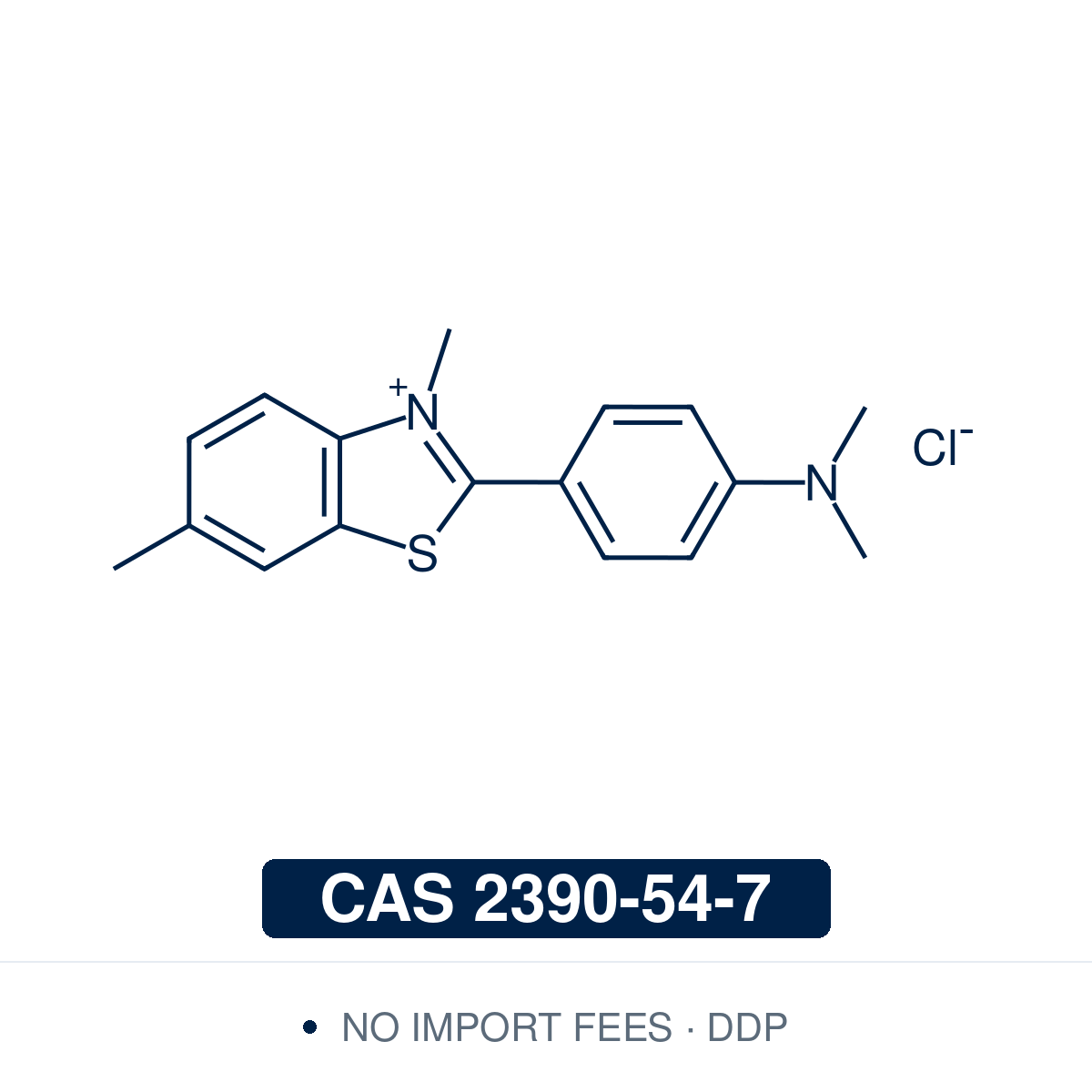
| SMILES | CC1=CC2=C(C=C1)[N+](=C(S2)C3=CC=C(C=C3)N(C)C)C.[Cl-] |
| InChI | InChI=1S/C17H19N2S.ClH/c1-12-5-10-15-16(11-12)20-17(19(15)4)13-6-8-14(9-7-13)18(2)3;/h5-11H,1-4H3;1H/q+1;/p-1 |
| InChIKey | JADVWWSKYZXRGX-UHFFFAOYSA-M |
| PubChem CID | 16953 |
| Molecular Formula | C₁₇H₁₉ClN₂S |
| Molecular Weight | 318.86 g/mol |
| Melting Point | 137.9 °C |
| Solubility | Slightly soluble in water soluble in methanol. |
| Purity | ≥95% |
| Physical Form | Yellow powder |
| HS Code | 3204.13 |
| Shelf Life | Retest period: 36 months from date of manufacture. |
| Storage Conditions | Store in a cool, dry place in a tightly sealed container, protected from light. |
Product Description & Scientific Applications
Thioflavin T is a water-soluble fluorogenic benzothiazole dye. The molecule has three parts, a benzothiazole ring, a benzene ring and a dimethylamino group; a methyl group on the benzothiazole nitrogen forces a non-planar geometry and largely sets the dye's photophysics.
Standard reagent for detecting amyloid fibril formation, the protein deposits associated with disorders such as Alzheimer's disease, Parkinson's disease and type II diabetes. The dye discriminates sharply between protein states: it does not bind native globular proteins, apart from acetylcholinesterase and serum albumins, nor molten-globule, unfolded or amorphous-aggregate states. In vitro, the appearance of its fluorescence is taken as an indication that fibrils have formed, and in tissue sections the dye is used to identify amyloid deposits.
Free dye absorbs maximally near 413 nm; on binding to fibrils the absorption and excitation maximum red-shifts to about 450 nm, and the bound dye is read in emission near 480 nm. The free dye has a molar extinction coefficient of about 3.2 × 10⁴ M⁻¹cm⁻¹ at 412 nm, used to set its concentration. In concentrated aqueous solution Thioflavin T self-associates and fluoresces as an excimer, with a signal distinct from that of the fibril-bound monomer.
The fluorescence switch is a molecular-rotor effect. In a low-viscosity solvent the benzothiazole and benzene rings rotate about their connecting bond in the excited state and reach a twisted, non-emissive state, so free dye in water is almost dark, with a quantum yield near 0.0001. Restricting that rotation, by confining the dye in a rigid site such as an amyloid fibril or by raising solvent viscosity, holds the molecule in its emissive state and raises the quantum yield by several orders of magnitude.
Thioflavin T binds as a monomer, and in the Krebs model it lies in the grooves formed by the side chains of the fibril β-sheets. A single fibril offers more than one binding mode: insulin fibrils present two, differing more than a hundredfold in binding constant, about 2 × 10⁷ against 1 × 10⁵ M⁻¹, and in brightness, with quantum yields of 0.83 and 0.30, so the signal depends on fibril structure.
Thioflavin T is also a light-up probe for G-quadruplex nucleic acids. It becomes fluorescent in the presence of G-quadruplex structures such as the human telomeric quadruplex, while single- and double-stranded oligonucleotides give a much smaller increase. With RNA the dye stacks on the G-tetrad and recognises RNA G-quadruplexes, setting them apart from other RNA folds.
Shipping Destinations
- EU & UK only: 3–7 business days.
- Classified as dangerous goods — shipping restrictions apply outside the EU/UK.
Safety Information
| GHS Pictograms |


|
| Signal Word | Danger |
| Hazard Class | UN 2811 — Toxic solid, organic, n.o.s. (Thioflavin T) (Class 6.1, PG III) |
| Transport Category | DG, UN 2811, Class 6.1, PG III (ADR/IATA/IMDG) |
| H-Statements | H301 - H317 - H318 - H410 |
| P-Statements | P261 - P264 - P270 - P272 - P273 - P280 - P301+P310 - P302+P352 - P305+P351+P338 - P310 - P330 - P333+P313 - P362+P364 - P391 - P405 - P501 |
Documentation
| Safety Data Sheet | Download PDF |