NorrChemica™
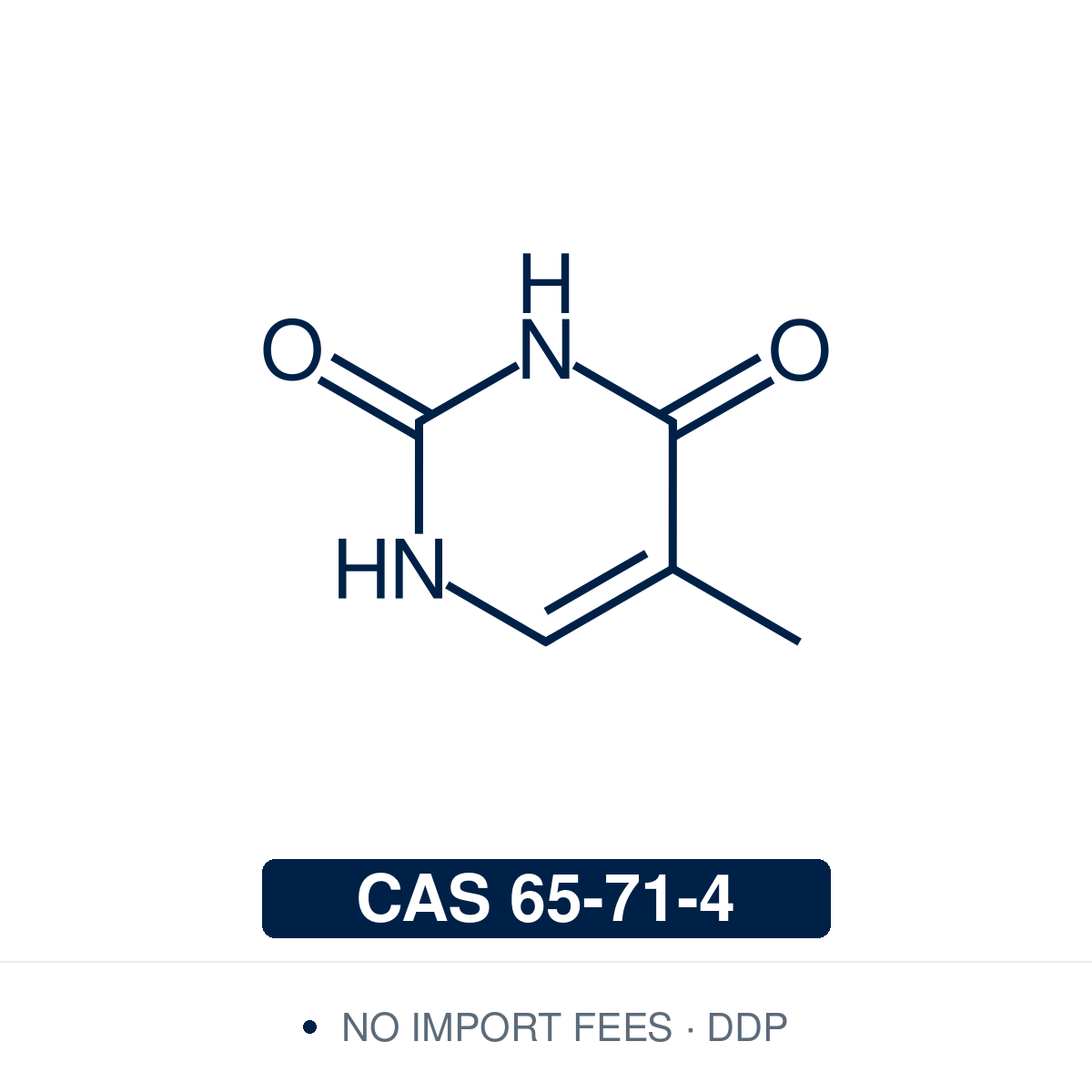
Thymine
Thymine | CAS 65-71-4 | ≥99%
Couldn't load pickup availability
Technical Specifications
| CAS Number | 65-71-4 |
| EC / EINECS Number | 200-616-1 |
| MDL Number | MFCD00006026 |
| RTECS Number | XP2100000 |
| SMILES | CC1=CNC(=O)NC1=O |
| InChI | InChI=1S/C5H6N2O2/c1-3-2-6-5(9)7-4(3)8/h2H,1H3,(H2,6,7,8,9) |
| InChIKey | RWQNBRDOKXIBIV-UHFFFAOYSA-N |
| PubChem CID | 1135 |
| Molecular Formula | C₅H₆N₂O₂ |
| Molecular Weight | 126.11 g/mol |
| Melting Point | 320–330 °C |
| Solubility | Sparingly soluble in water at RT; soluble in dilute alkali, dilute acid, and DMF; slightly soluble in ethanol |
| Purity | ≥99% |
| Physical Form | White crystalline powder |
| HS Code | 2933.59 |
| Shelf Life | Retest period: 36 months from date of manufacture |
| Storage Conditions | Store at room temperature in a tightly sealed container, protected from moisture |
Product Description & Scientific Applications
Thymine (5-methylpyrimidine-2,4(1H,3H)-dione; 5-methyluracil) is one of the four canonical DNA nucleobases and the adenine partner in the Watson–Crick T·A pair (N3-H···N1 and C4=O···H-N6). The C5-methyl distinguishes it from uracil and is the marker by which repair recognises uracil from cytosine deamination as abnormal. UV absorption peaks at 263.8 nm; the fluorescence quantum yield is low (ΦF ≈ 1×10⁻⁴), from ultrafast non-radiative decay.
UV photochemistry and pyrimidine dimers. Thymine is the standard model for UV photochemistry. At adjacent pyrimidines, cyclobutane pyrimidine dimers form by [2+2] cycloaddition of two stacked C5=C6 bonds — cis-syn dominant in B-DNA, barrierless, complete in ~1 ps, quantum yield ~1%. Pyrimidine (6-4) photoproducts form by a Paternò–Büchi reaction between the 5′-C5=C6 bond and the 3′-C4 carbonyl via an oxetane; they are less abundant, more efficiently excised by nucleotide excision repair, and isomerise to Dewar forms under UVA. Thymine, thymidine, and TpT model dimer kinetics, photoreversal, and photolyase recognition.
Watson–Crick recognition. The T·A pair is the benchmark two-bond pair for base-pair thermodynamics, and thymine is built into receptors, macrocycles, and supramolecular assemblies that recognise adenine and ATP.
Nucleoside synthesis. Persilylated thymine (HMDS or BSA) couples to a peracylated sugar under TMSOTf or SnCl4 in acetonitrile or 1,2-dichloroethane to give thymidine and modified analogues; unprotected thymine can give the N3-glycoside, so N3 is masked as the N3-benzoyl when regiocontrol matters.
PNA monomer. N1-alkylation with bromo- or chloroacetate, hydrolysis, and coupling to the aminoethylglycine backbone give the thymine PNA monomer. Lacking an exocyclic amine, thymine needs no base protection — the shortest of the four canonical PNA monomer routes.
Analytical standard. Reference for HPLC-UV and LC-MS/MS quantification of pyrimidine bases and catabolites, with labelled thymine as internal standard.
Shipping Destinations
- EU & UK: Priority delivery, 2–5 business days.
- United States (DDP): 3–7 business days, duties and taxes prepaid.
- EFTA Countries (DDP): 3–7 business days, duties and taxes prepaid.
- Worldwide: 7–14 business days, selected locations.
Safety Information
| Hazard Class | None — not subject to transport regulations |
| Transport Category | Not classified as dangerous goods for transport (ADR/IATA/IMDG) |
Documentation
| Safety Data Sheet | Download PDF |
Share