NorrChemica™
Titanocene Dichloride (Cp2TiCl2)
Titanocene Dichloride (Cp2TiCl2) | CAS 1271-19-8 | ≥98%
| Pack size | Excl. VAT | Incl. VAT | Add to cart |
|---|---|---|---|
| 25 g | €96,20 | ||
| 100 g | €129,20 |
Taxes and fees, e.g. VAT, included in the price. Shipping calculated at checkout.Free shipping on EU, UK and EFTA orders above €250, and above €400 to the rest of the world.
Technical Specifications
| CAS Number | 1271-19-8 |
| EC / EINECS Number | 215-035-9 |
| MDL Number | MFCD00003723 |
| RTECS Number | XR2050000 |
| SMILES | [CH-]1C=CC=C1.[CH-]1C=CC=C1.[Cl-].[Cl-].[Ti+4] |
| InChI | InChI=1S/2C5H5.2ClH.Ti/c2*1-2-4-5-3-1;;;/h2*1-5H;2*1H;/q2*-1;;;+4/p-2 |
| InChIKey | YMNCCEXICREQQV-UHFFFAOYSA-L |
| PubChem CID | 76030824 |
| Molecular Formula | C₁₀H₁₀Cl₂Ti |
| Molecular Weight | 248.96 g/mol |
| Melting Point | 289 °C (dec.) |
| Solubility | Soluble in tetrahydrofuran, dichloromethane, chloroform and toluene. Moderately soluble in ethanol. Insoluble in diethyl ether, benzene, carbon disulfide, carbon tetrachloride and petroleum ether. Slowly hydrolyses in water. |
| Purity | ≥98% |
| Physical Form | Orange to brown to dark red powder to crystal |
| HS Code | 2931.90 |
| Shelf Life | Retest period: 24 months from date of manufacture |
| Storage Conditions | Stable in dry air; hydrolyses slowly in moist air. Store at 2-8 °C in a tightly sealed container, protected from moisture |
Product Description & Scientific Applications
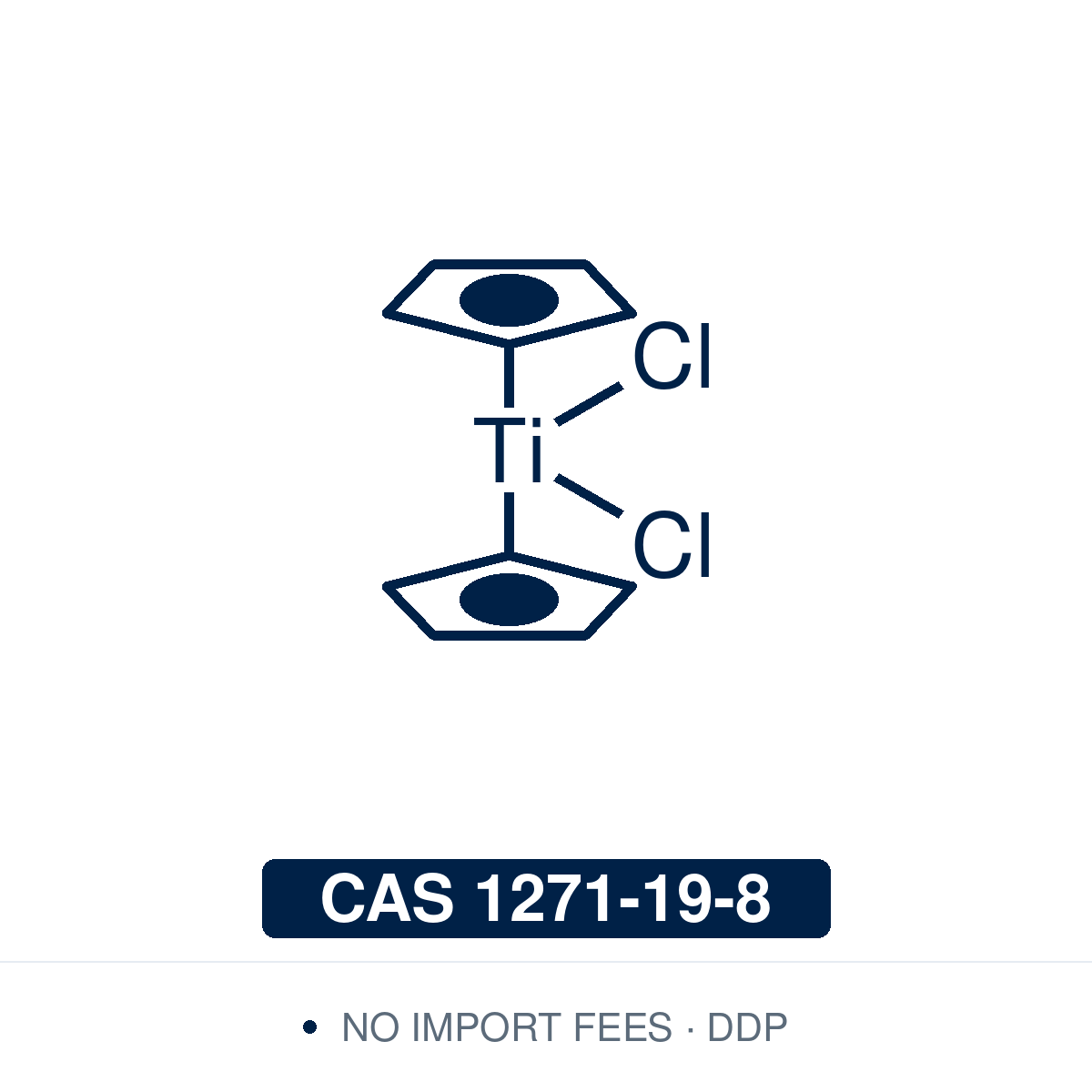
Titanocene dichloride, Cp2TiCl2 or bis(cyclopentadienyl)titanium dichloride (C10H10Cl2Ti, 248.96 g/mol), is a titanium(IV) metallocene — a bent metallocene, the geometry that leaves its chloride sites open for substrate binding.
It is a bench-stable precatalyst, not the active species. Base metals such as zinc or manganese reduce it in situ to the Ti(III) reagent that does the chemistry, and that Ti(III) species opens epoxides homolytically. Everything below follows from that.
Unusually for radical chemistry, water is tolerated and can be the hydrogen source. Titanocene(III) aqua complexes are a distinct class of hydrogen-atom-transfer reagent, working because water binds strongly to Ti(III) and the HAT step has a low activation energy.
Applications and Reactions
- Radical epoxide opening: with collidine hydrochloride and a hydrogen-atom donor it delivers the diol in 86% yield with high diastereocontrol.
- Hydrogen transfer from water: with a substoichiometric late transition metal it hydrogenates alkenes and alkynes under mild conditions, the hydrogen atom coming from Ti(III)-coordinated water rather than from H2 or a hydride.
- Reductive annulation: with zinc it drives titanium(III)-catalysed reductive annulation, forging a tricyclic diol core in one step.
- Epoxy-ene cyclisation: closes a trans-decalin in 58% yield, assembling a fused bicyclic skeleton in a single radical step.
- Tebbe olefination: combined with trimethylaluminium it forms the Tebbe reagent, olefinating a carbonyl in 90% yield.
- Pinacol coupling: at 5 mol% it promotes diastereoselective pinacol coupling of aromatic aldehydes, and is non-toxic, inexpensive and readily available at that loading.
- Catalyst screening: in one titanium-catalyst screen it was the most efficient of the complexes tested, giving the target in 35% yield.
- Olefin polymerisation: as a precatalyst it out-performed two salicylaldimine titanium(IV) dichlorides in ethylene slurry polymerisation.
- Storage: stable in dry air, hydrolyses slowly in moist air. Store at 2–8 °C in a tightly sealed container, protected from moisture.
Shipping Destinations
- EU & UK: Priority delivery, 2–5 business days.
- United States (DDP): 3–7 business days, duties and taxes prepaid.
- EFTA Countries (DDP): 3–7 business days, duties and taxes prepaid.
- Worldwide: 7–14 business days, selected locations.
Safety Information
| GHS Pictograms |

|
| Signal Word | Warning |
| Hazard Class | Not classified as dangerous goods |
| Transport Category | Not dangerous goods (ADR/IATA/IMDG) |
| H-Statements | H315 - H319 - H335 |
| P-Statements | P280 - P302+P352 - P304+P340 - P312 - P332+P313 - P337+P313 |
Documentation
| Safety Data Sheet | Download PDF |