NorrChemica™
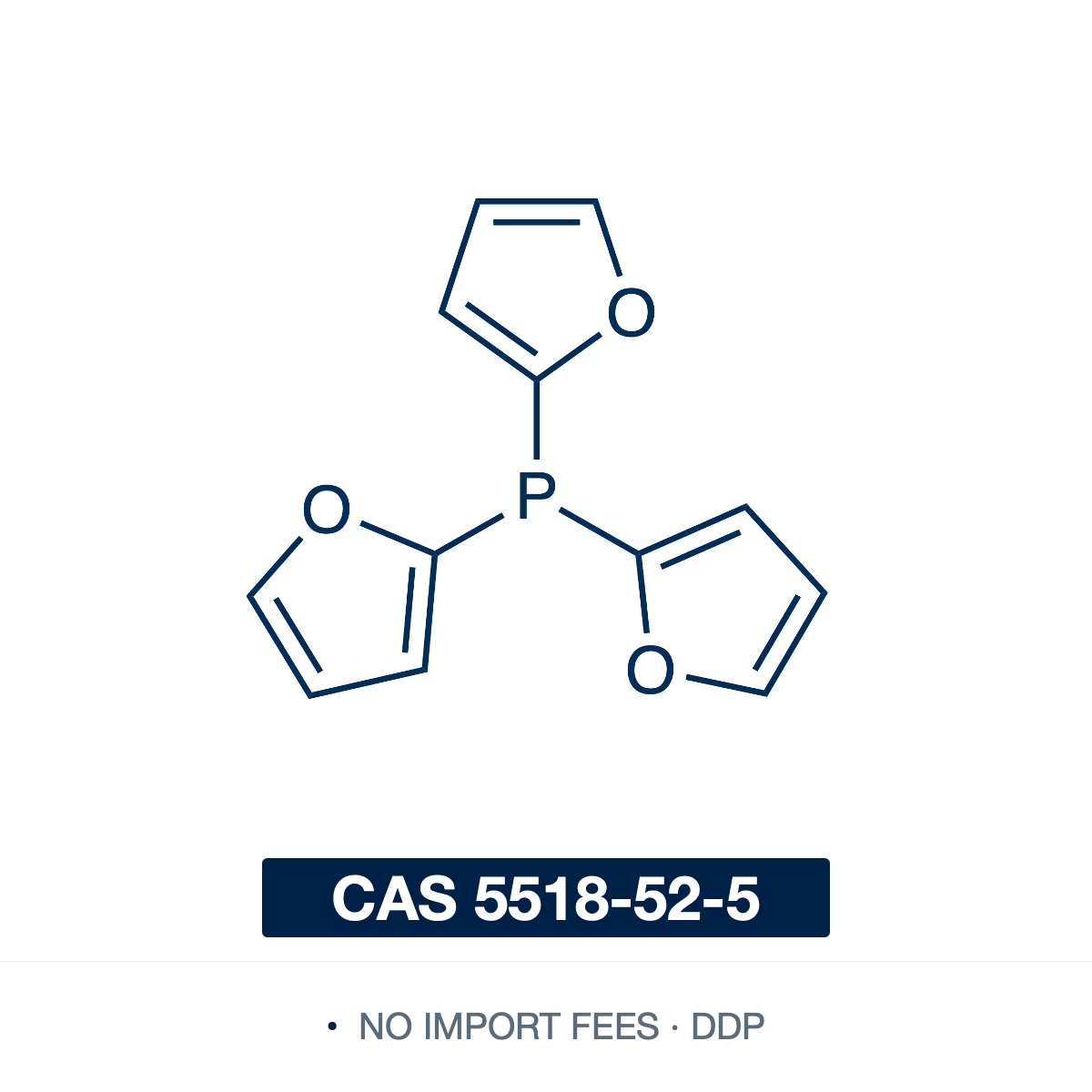
Tri(2-furyl)phosphine
Tri(2-furyl)phosphine | CAS 5518-52-5 | ≥98%
Couldn't load pickup availability
Technical Specifications
| CAS Number | 5518-52-5 |
| EC / EINECS Number | 628-036-8 |
| MDL Number | MFCD00151857 |
| SMILES | C1=COC(=C1)P(C2=CC=CO2)C3=CC=CO3 |
| InChI | InChI=1S/C12H9O3P/c1-4-10(13-7-1)16(11-5-2-8-14-11)12-6-3-9-15-12/h1-9H |
| InChIKey | DLQYXUGCCKQSRJ-UHFFFAOYSA-N |
| PubChem CID | 521585 |
| Molecular Formula | C₁₂H₉O₃P |
| Molecular Weight | 232.17 g/mol |
| Melting Point | 61-64 °C |
| Solubility | Practically insoluble in water, soluble in common organic solvents |
| Purity | ≥98% |
| Physical Form | White to off-white crystalline powder |
| HS Code | 2931.49 |
| Shelf Life | Retest period: 36 months from date of manufacture |
| Storage Conditions | Store in a cool, dry place in a tightly sealed container |
Product Description & Scientific Applications
Tri(furan-2-yl)phosphine (tri-2-furylphosphine, TFP) is a heteroaryl triarylphosphine in which three furan-2-yl rings are bound to phosphorus. The 2-furyl ring is more electron-withdrawing than phenyl, so phosphorus is a markedly poorer σ-donor than in triphenylphosphine, even though the two ligands are of similar steric demand (Tolman cone angles ≈ 133° for TFP and ≈ 145° for PPh₃). The result is a weakly donating, readily dissociated ligand — a property shared with triphenylarsine — that frequently makes TFP-based palladium catalysts more active than their triphenylphosphine analogues.
Palladium-catalysed Stille coupling
TFP is the classic accelerating ligand for the Stille reaction. Farina and Krishnan showed that replacing triphenylphosphine with tri-2-furylphosphine, or with triphenylarsine, produces large rate accelerations — typically two to three orders of magnitude — in the palladium-catalysed coupling of organostannanes with aryl and vinyl halides and triflates. Because the ligand is weakly bound and readily dissociated, it favours coordinatively unsaturated palladium intermediates and opens a coordination site for the incoming organotin reagent, accelerating transmetalation — the rate-limiting step in many Stille couplings; consistent with this, added excess phosphine slows the reaction. The practical consequence is faster coupling under milder conditions, which attenuates unwanted side reactions and suits sensitive or complex substrates; this combination has made tri-2-furylphosphine a common ligand choice for Stille couplings in target-oriented synthesis. It is commonly paired with palladium sources such as Pd₂(dba)₃ or Pd(OAc)₂, sometimes with additives such as copper(I) iodide or lithium chloride.
Other palladium-catalysed transformations
Beyond the Stille reaction, TFP serves as a labile supporting ligand across a broader range of palladium catalysis. Supplier and literature sources document its use in Suzuki–Miyaura, Negishi, Sonogashira and Heck couplings, in Buchwald–Hartwig amination, and in cycloisomerisation chemistry. It has also been applied in palladium-catalysed alkene carboamination, including TFP/Pd systems used to assemble morpholine and pyrrolidine derivatives. In Stille chemistry this lability is directly tied to faster transmetalation; in broader palladium catalysis it makes TFP a useful supporting ligand where rapid ligand exchange or coordinatively unsaturated species are beneficial.
Coordination chemistry and ligand benchmarking
TFP forms discrete palladium complexes — including cationic bis(phosphine) palladium(II) species — and metal-carbonyl cluster derivatives; in triosmium cluster chemistry it undergoes C–H and P–C activation of the furyl ring to give furyne- and phosphinidene-containing clusters. Because its steric demand is broadly comparable to triphenylphosphine while its donor strength is distinctly lower, TFP also serves as a convenient reference ligand — together with triphenylarsine — for probing how soft, weakly donating ligands influence oxidative addition, transmetalation and reductive elimination.
Further reading: For phosphine-ligand selection, palladium sources and precatalysts, and Suzuki–Miyaura and Buchwald–Hartwig reagent choice, see NorrChemica's Lab Journal guide: Choosing a Phosphine Ligand for Cross-Coupling: A Practical Guide.
Shipping Destinations
- EU & UK: Priority delivery, 2–5 business days.
- United States (DDP): 3–7 business days, duties and taxes prepaid.
- EFTA Countries (DDP): 3–7 business days, duties and taxes prepaid.
- Worldwide: 7–14 business days, selected locations.
Safety Information
| GHS Pictograms |

|
| Signal Word | Warning |
| Hazard Class | Not regulated for transport |
| Transport Category | Not classified as dangerous goods for transport (ADR/IATA/IMDG) |
| H-Statements | H315 - H319 - H335 |
| P-Statements | P261 - P264 - P271 - P280 - P302+P352 - P305+P351+P338 - P332+P313 - P337+P313 - P362+P364 - P501 |
Documentation
| Safety Data Sheet | Download PDF |