NorrChemica™
Tri-o-tolylphosphine (P(o-tol)₃)
Tri-o-tolylphosphine (P(o-tol)₃) | CAS 6163-58-2 | ≥98%
Couldn't load pickup availability
Technical Specifications
| CAS Number | 6163-58-2 |
| EC / EINECS Number | 228-193-9 |
| MDL Number | MFCD00008514 |
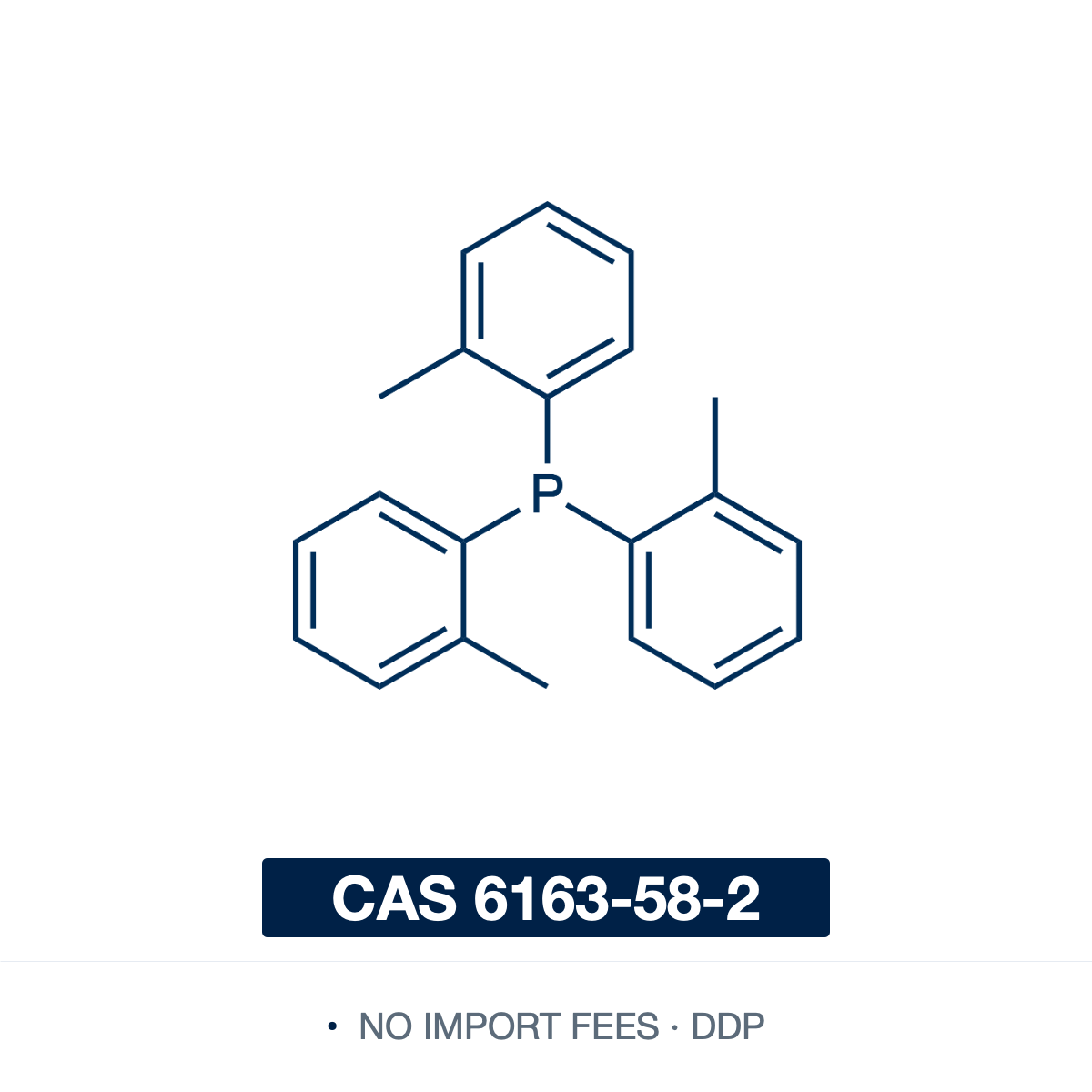
| SMILES | CC1=CC=CC=C1P(C2=CC=CC=C2C)C3=CC=CC=C3C |
| InChI | InChI=1S/C21H21P/c1-16-10-4-7-13-19(16)22(20-14-8-5-11-17(20)2)21-15-9-6-12-18(21)3/h4-15H,1-3H3 |
| InChIKey | COIOYMYWGDAQPM-UHFFFAOYSA-N |
| PubChem CID | 80271 |
| Molecular Formula | C21H21P |
| Molecular Weight | 304.37 g/mol |
| Melting Point | 123-125 °C |
| Solubility | Insoluble in water, soluble in common organic solvents |
| Log Pow | >7.2 |
| Purity | ≥98% |
| Physical Form | White to off-white crystalline powder |
| HS Code | 2931.49 |
| Shelf Life | Retest period: 36 months from date of manufacture |
| Storage Conditions | Store under inert gas (N₂ or Ar) in a tightly sealed container in a cool, dry place |
Product Description & Scientific Applications
Tris(o-tolyl)phosphine (tri-o-tolylphosphine, P(o-tol)3) is a classic bulky triarylphosphine and a well-established ligand in palladium-catalysed cross-coupling. Three ortho-methyl groups give it an unusually large cone angle of about 194°, well beyond the 145° of triphenylphosphine, and this steric profile shapes its coordination behaviour. It is a white crystalline solid, convenient to handle and soluble in common organic solvents; in solution it slowly oxidises to the corresponding phosphine oxide. The defining consequence of the ortho-tolyl substitution is facile cyclometalation at palladium(II): reaction with palladium(II) acetate forms the thermally stable Herrmann–Beller palladacycle, a ubiquitous precatalyst for arylative Heck chemistry.
Mizoroki–Heck reaction and the Herrmann–Beller palladacycle. P(o-tol)3 is the ligand precursor to the Herrmann–Beller palladacycle formed from palladium(II) acetate. This well-defined palladacyclic precatalyst is thermally stable and acts as a reservoir for the active Pd–P(o-tol)3 species. In arylative Heck chemistry it reaches very high turnover numbers — up to the order of 106 for aryl bromides — and extends to selected aryl chlorides under promoter-salt conditions such as tetrabutylammonium bromide.
First-generation Buchwald–Hartwig amination. P(o-tol)3 belongs to the first-generation ligand set for palladium-catalysed C–N coupling. The classic Pd[P(o-tol)3]2 system established aryl-bromide amination with secondary amines and provided the mechanistic foundation — oxidative addition, amido-palladium intermediates, and C–N reductive elimination. Coupling of primary amines and broader scope came with later ligand families; P(o-tol)3 remains the first-generation benchmark.
Other palladium cross-couplings. Beyond Heck and C–N coupling, P(o-tol)3 is a useful screening ligand in Suzuki–Miyaura, Negishi and Stille chemistry, particularly where a sterically demanding but commercially accessible triarylphosphine is wanted. Its large cone angle and cyclometalation tendency set it apart from less hindered triarylphosphines such as triphenylphosphine.
Cyclometalation and coordination chemistry. Treatment with metal halides or acetates gives cyclometalated complexes through activation of an ortho-methyl aryl C–H bond. These well-defined complexes are common in homogeneous catalysis and are the entry point to the palladacycle chemistry above.
Other uses. Reaction with elemental selenium gives the corresponding tri-o-tolylphosphine selenide; such phosphine selenides serve as a standard probe of phosphine σ-donor strength. This is secondary to the ligand's major role in palladium and palladacycle catalysis.
Handling. Tris(o-tolyl)phosphine is convenient to handle as a crystalline solid, but its solutions slowly oxidise to the phosphine oxide. Minimise prolonged air exposure where ligand purity is critical.
Further reading: For phosphine-ligand selection, palladium sources and precatalysts, and Suzuki–Miyaura and Buchwald–Hartwig reagent choice, see NorrChemica's Lab Journal guide: Choosing a Phosphine Ligand for Cross-Coupling: A Practical Guide.
Shipping Destinations
- EU & UK: Priority delivery, 2–5 business days.
- United States (DDP): 3–7 business days, duties and taxes prepaid.
- EFTA Countries (DDP): 3–7 business days, duties and taxes prepaid.
- Worldwide: 7–14 business days, selected locations.
Safety Information
| Hazard Class | Not regulated for transport |
| Transport Category | Not classified as dangerous goods for transport (ADR/IATA/IMDG) |
Documentation
| Safety Data Sheet | Download PDF |
Share