NorrChemica™
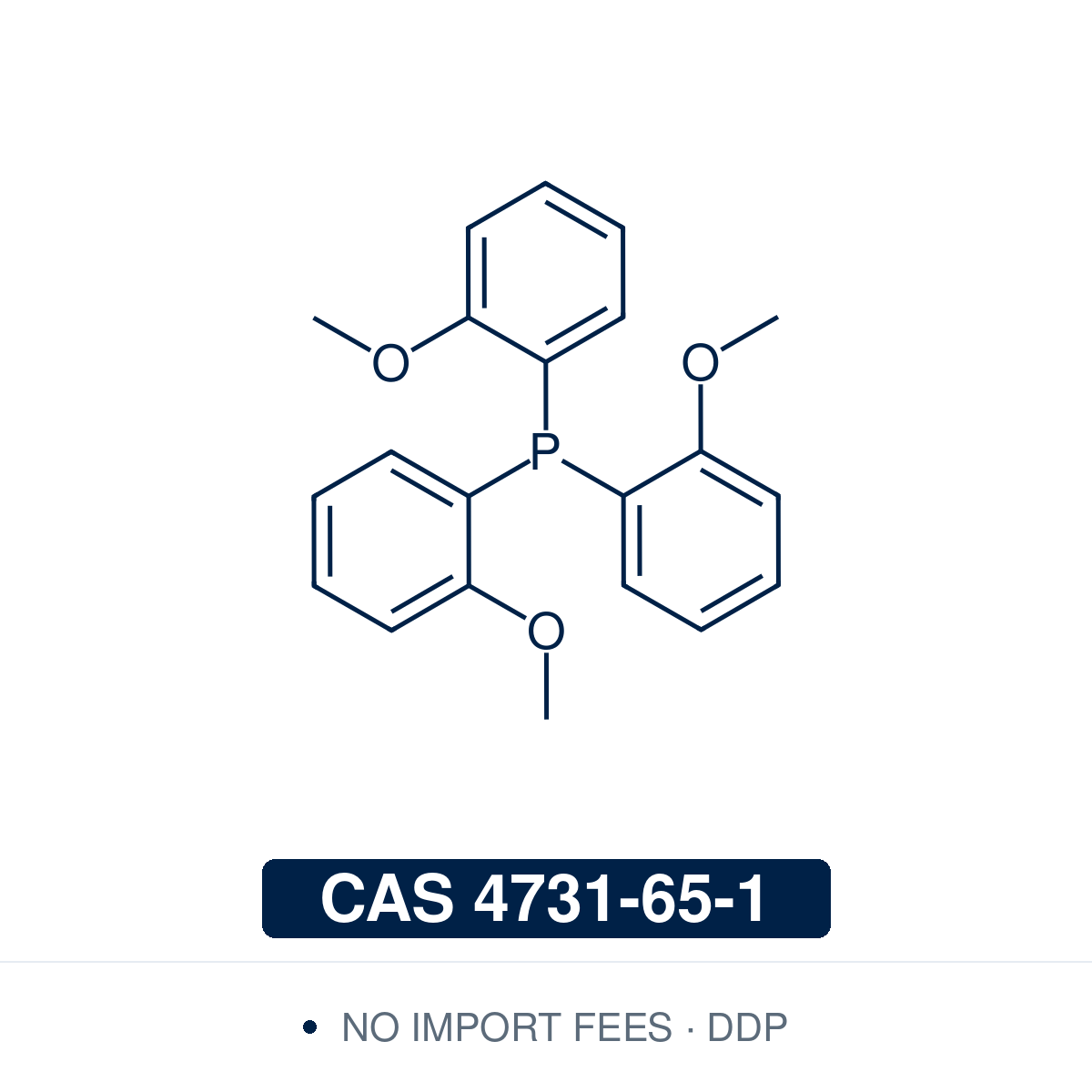
Tris(2-methoxyphenyl)phosphine
Tris(2-methoxyphenyl)phosphine | CAS 4731-65-1 | ≥97%
| Pack size | Excl. VAT | Incl. VAT | Add to cart |
|---|---|---|---|
| 500 mg | €29,20 | ||
| 1.0 g | €37,20 | ||
| 2.0 g | €45,20 | ||
| 5.0 g | €57,20 | ||
| 10 g | €74,20 | ||
| 25 g | €119,20 | ||
| 50 g | €198,20 | ||
| 100 g | €329,20 | ||
| 250 g | €798,20 |
Taxes and fees, e.g. VAT, included in the price. Shipping calculated at checkout.Free shipping on EU, UK and EFTA orders above €250, and above €400 to the rest of the world.
Technical Specifications
| CAS Number | 4731-65-1 |
| EC / EINECS Number | 225-235-8 |
| MDL Number | MFCD00014892 |
| SMILES | COC1=CC=CC=C1P(C2=CC=CC=C2OC)C3=CC=CC=C3OC |
| InChI | InChI=1S/C21H21O3P/c1-22-16-10-4-7-13-19(16)25(20-14-8-5-11-17(20)23-2)21-15-9-6-12-18(21)24-3/h4-15H,1-3H3 |
| InChIKey | IIOSDXGZLBPOHD-UHFFFAOYSA-N |
| PubChem CID | 78464 |
| Molecular Formula | C₂₁H₂₁O₃P |
| Molecular Weight | 352.4 g/mol |
| Melting Point | 198–204 °C |
| Solubility | Insoluble in water, soluble in common organic solvents |
| Purity | ≥97% |
| Physical Form | White to almost white powder to crystal |
| HS Code | 2931.49 |
| Shelf Life | Retest period: 36 months from date of manufacture |
| Storage Conditions | Keep container tightly closed. Store at room temperature; a cool, dark place below 15 °C is recommended. |
| SDS / CoA | Download PDF |
Product Description & Scientific Applications
Tris(2-methoxyphenyl)phosphine (tri-o-anisylphosphine, P(o-anisyl)₃) is a monodentate, electron-rich triarylphosphine ligand for palladium. Electron density at phosphorus rises with the number of methoxy groups on the phenyl rings, and one group on every ring is the optimum. Further substitution only adds steric hindrance, which impedes substrate coordination and lowers catalyst activity.
It is the most widely used ligand for direct arylation, and increasing its loading per palladium centre does not improve catalytic activity. It is also the reference ligand against which new ortho-substituted phosphines are benchmarked in polymerisation. It is readily available from anisole and relatively air-stable.
Applications and Reactions
- Direct arylation polymerisation: It is paired with a palladium dibenzylideneacetone source, pivalic acid and caesium carbonate in toluene. Density functional theory attributes its effect to suppression of head-to-head and tail-to-tail linkages, which raises the regioregularity of the polymer produced.
- Direct C–H heteroarylation: With the Herrmann palladacycle it gives conjugated copolymers at high molecular weight. On small molecules the same system arylates heteroaryl bromides, with potassium carbonate as base and pivalic acid as proton shuttle. A palladium acetate variant of the same coupling runs with caesium carbonate and caesium pivalate.
- Hindered Suzuki biaryls: With palladium acetate it couples aryl bromides with arylboronic acids and is chosen where the biaryl is congested: with ortho-methyl aryl halides it raised the isolated yield from 64-69% to 96%.
- Butadiene telomerization: In palladium-catalysed telomerization of glycerol with 1,3-butadiene it gave the maximum activity of the phosphines screened, reaching a comparable yield in 0.5 instead of 5 h. The same pairing telomerizes 1,3-butadiene with carbon dioxide to an unsaturated δ-lactone, with significantly increased yields.
- Coupling at hindered carbons: It couples organocopper(I) reagents under palladium acetate, joining a 9-triptycenylcopper(I) complex where the boronate ester and zinc analogues gave none.
- Carborane functionalisation: A palladium catalyst supported by this ligand is the optimal system for building densely functionalised icosahedral carboranes.
- Documented limits: In Buchwald-Hartwig amination with palladium acetate it gives only moderate to good conversion, in the same range as triphenylphosphine under the same ligand screen. In direct heteroarylation it may prevent homocoupling between the electron-poor comonomer units, but homocoupling at other positions and backbone defects can still arise.
Further Reading
Practical guidance on choosing a phosphine ligand for palladium- and nickel-catalysed cross-coupling in NorrChemica's Lab Journal: Phosphine Ligands for Cross-Coupling.
Shipping Destinations
- EU & UK: Priority delivery, 3–5 business days.
- United States (DDP): 3–7 business days, duties and taxes prepaid.
- EFTA Countries (DDP): 3–7 business days, duties and taxes prepaid.
- Worldwide: 7–14 business days, selected locations.
Safety Information
| GHS Pictograms |

|
| Signal Word | Warning |
| Hazard Class | Not regulated for transport |
| Transport Category | Not classified as dangerous goods for transport (ADR/IATA/IMDG) |
| H-Statements | H315 - H319 - H335 - H413 |
| P-Statements | P261 - P264 - P264+P265 - P271 - P273 - P280 - P302+P352 - P304+P340 - P305+P351+P338 - P319 - P321 - P332+P317 - P337+P317 - P362+P364 - P403+P233 - P405 - P501 |
Documentation
| Safety Data Sheet | Download PDF |