NorrChemica™
Umbelliferone (7-Hydroxycoumarin)
Umbelliferone (7-Hydroxycoumarin) | CAS 93-35-6 | ≥98%
Couldn't load pickup availability
Technical Specifications
| CAS Number | 93-35-6 |
| EC / EINECS Number | 202-240-3 |
| MDL Number | MFCD00006878 |
| RTECS Number | GN6820000 |
| SMILES | C1=CC(=CC2=C1C=CC(=O)O2)O |
| InChI | InChI=1S/C9H6O3/c10-7-3-1-6-2-4-9(11)12-8(6)5-7/h1-5,10H |
| InChIKey | ORHBXUUXSCNDEV-UHFFFAOYSA-N |
| PubChem CID | 5281426 |
| Molecular Formula | C₉H₆O₃ |
| Molecular Weight | 162.14 g/mol |
| Melting Point | 230 °C (dec.) |
| Solubility | Soluble in DMSO, methanol, acetone, dioxane, sparingly soluble in cold water |
| Purity | ≥98% |
| Physical Form | White to pale yellow solid |
| HS Code | 2932.20 |
| Country of Origin | Finland |
| Shelf Life | Retest period: 36 months from date of manufacture |
| Storage Conditions | Store in a cool, dry place in a tightly sealed container, protected from light |
Product Description & Scientific Applications
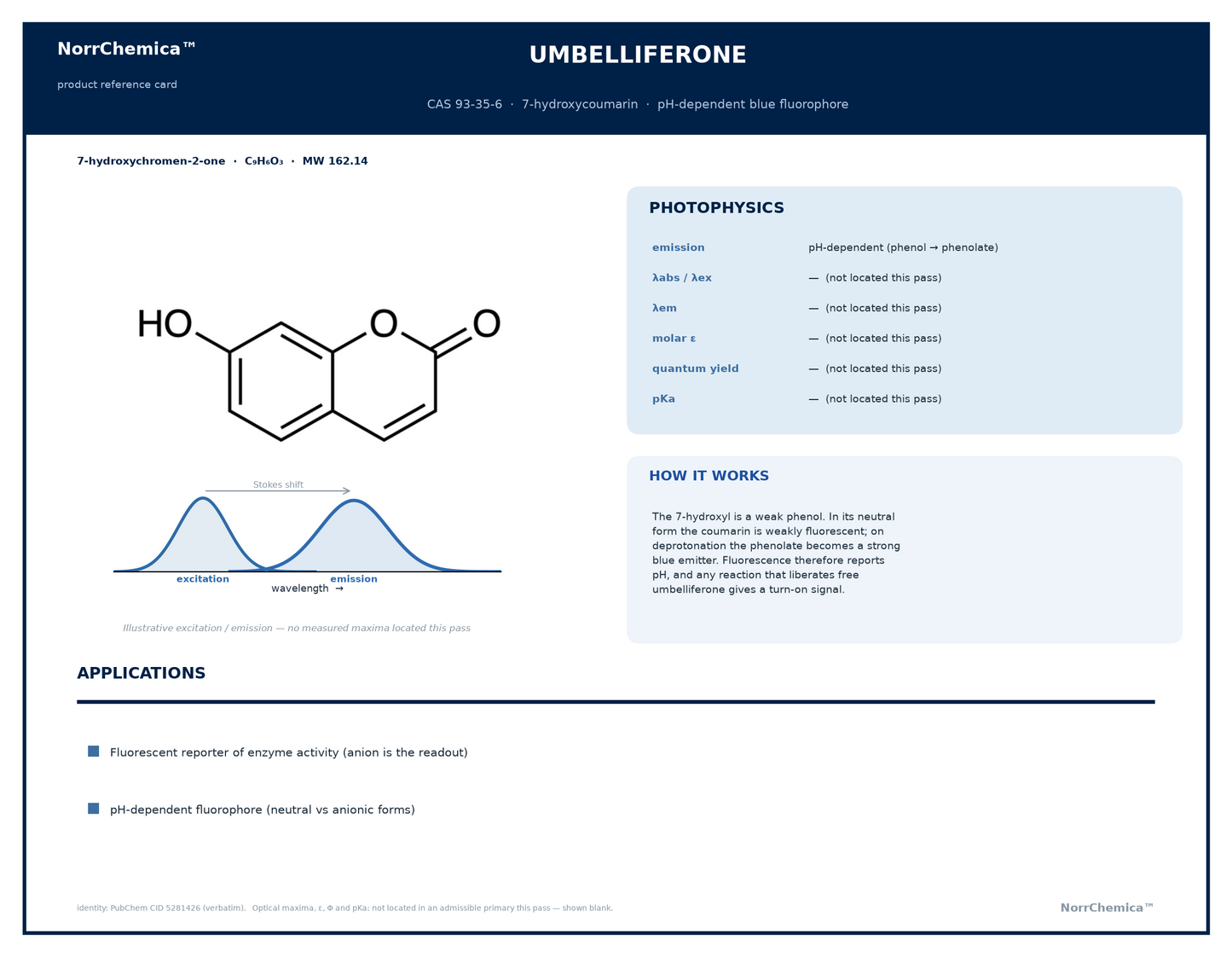
The 7-hydroxy group makes umbelliferone a photoacid: on excitation the phenolic proton becomes far more acidic than in the ground state and is transferred to solvent. In water its excited-state acidity constant pKa* is about 0.4, and excited-state proton transfer (ESPT) to water proceeds at 2 × 10¹⁰ s−1. The excited molecule is also a photobase, taking up a proton from weak acids such as acetic acid. ESPT is solvent-gated: fast in water, but in methanol much slower than nonradiative decay of the excited singlet, so its efficiency there is low. Ground-state acidity is milder — the phenol pKa reported for the dye tethered in a single DNA strand is 8.8, rising above 10 on intercalation into a duplex. Protonation quenches the fluorescence and deprotonation to the anion restores it, so emission reports the protonation state, and both absorption and emission are solvatochromic. In nature, umbelliferone is a coumarin that accumulates in plant leaves and stems near sites of microbial infection, where sunlight-driven ESPT is proposed to act as a resistance mechanism against fungal and bacterial attack.
Applications
Umbelliferone is a reporting fluorophore across several sensing formats, and the unsubstituted parent of the 7-hydroxycoumarin fluorophores, whose ESPT and prototropic kinetics are tuned by substitution:
- pH and hybridisation sensing — as a quencher-free molecular beacon, the phenol pKa rises by more than 1.2 units on duplex formation, so that at pH 8.5 the duplex fluoresces about one-fifteenth as strongly as the single strand, and target binding that opens the beacon raises emission roughly tenfold.
- FRET donor for enzyme sensing — as a blue emitter it serves as a Förster resonance energy transfer donor; in a ratiometric two-photon probe for γ-glutamyltranspeptidase the 7-hydroxycoumarin donor emits near 461 nm against a BODIPY acceptor at 610 nm, and enzyme turnover that separates the chromophores restores the donor band.
- FRET donor in a metal–organic framework — as 7-hydroxycoumarin-4-acetic acid, encapsulated in a zirconium MOF as the donor to a fluorescein acceptor in a ratiometric bacterial nanoprobe.
- Hydrogen peroxide sensing — umbelliferone-based probes give large fluorescence turn-on, up to one hundredfold, with good selectivity over other reactive oxygen species; the signal is the liberated umbelliferone once an oxidatively cleaved cage is removed.
- Metal-ion sensing — the 7-hydroxycoumarin moiety is the reporting unit in turn-on fluoroionophores for metal ions such as Mg(II).
- Mitochondrial pH imaging — the substituted derivative 3-benzimidazole-7-hydroxycoumarin is a mitochondria-localised two-photon probe with linear pH response around pKa 4.20 and 7.20 at 480 nm emission.
- Genetically encoded fluorophore — the amino acid l-(7-hydroxycoumarin-4-yl)ethylglycine carries the fluorophore into proteins for FRET-based readout of transcription-factor binding in living bacteria.
Shipping Destinations
- EU & UK: Priority delivery, 2–5 business days.
- United States (DDP): 3–7 business days, duties and taxes prepaid.
- EFTA Countries (DDP): 3–7 business days, duties and taxes prepaid.
- Worldwide: 7–14 business days, selected locations.
Safety Information
| Hazard Class | Not regulated for transport |
| Transport Category | Not classified as dangerous goods for transport (ADR/IATA/IMDG) |
Documentation
| Safety Data Sheet | Download PDF |
Share