NorrChemica™
Victoria Blue B
Victoria Blue B | CAS 2580-56-5 | ≥98%
Couldn't load pickup availability
Technical Specifications
| CAS Number | 2580-56-5 |
| EC / EINECS Number | 219-943-6 |
| MDL Number | MFCD00011878 |
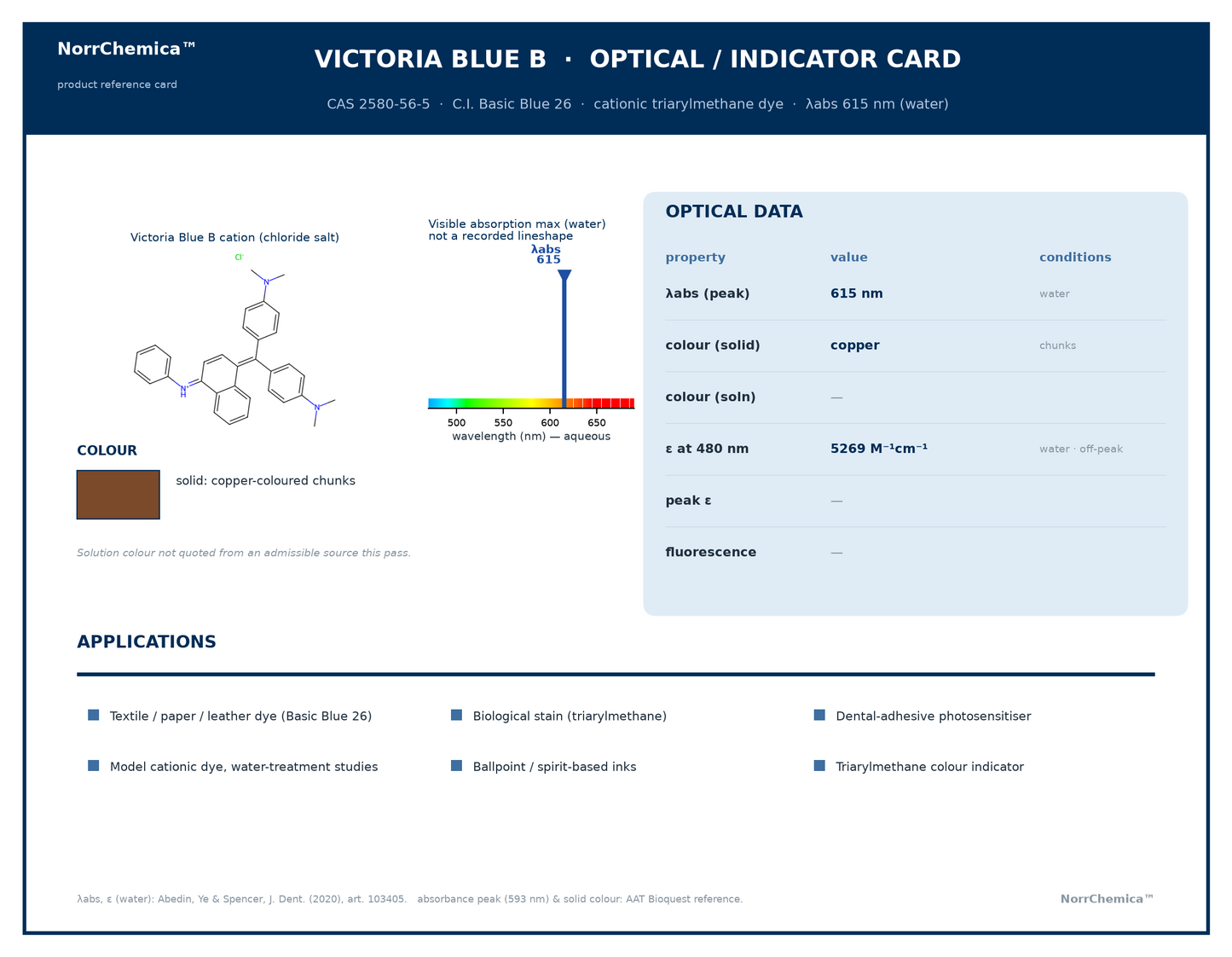
| SMILES | CN(C)C1=CC=C(C=C1)C(=C2C=CC(=[NH+]C3=CC=CC=C3)C4=CC=CC=C24)C5=CC=C(C=C5)N(C)C.[Cl-] |
| InChI | InChI=1S/C33H31N3.ClH/c1-35(2)27-18-14-24(15-19-27)33(25-16-20-28(21-17-25)36(3)4)31-22-23-32(30-13-9-8-12-29(30)31)34-26-10-6-5-7-11-26;/h5-23H,1-4H3;1H |
| InChIKey | LLWJPGAKXJBKKA-UHFFFAOYSA-N |
| PubChem CID | 17407 |
| Molecular Formula | C33H32ClN3 |
| Molecular Weight | 506.08 g/mol |
| Melting Point | 206 °C (dec.) |
| Solubility | Soluble in hot water, methanol, and lower alcohols; soluble in diethyl ether. Gives an intensely blue-violet solution. |
| Log Pow | 0.929 |
| Purity | ≥98% |
| Physical Form | Dark blue to violet powder |
| HS Code | 3204.13 |
| Country of Origin | Finland |
| Shelf Life | Retest period: 36 months from date of manufacture |
| Storage Conditions | Store in a cool, dry place in a tightly sealed container, protected from light |
Product Description & Scientific Applications
Victoria Blue B is a deep-blue, lipid-soluble cationic dye of the triarylmethane class, listed in the Colour Index as CI 44045. Two features govern its behaviour: its positive charge, which lets the cation pair tightly with anions, and its lipophilic character, which lets the dye cross lipid-rich membranes into cells and organelles.
Common Scientific Applications
Nuclear stain for cytology. As the tetrafluoroborate salt, Victoria Blue B is a selective nuclear stain: under appropriate conditions it colours only cell nuclei while the background stays completely clear, and the bound dye stands in a quantitative relationship to the nuclear substrate. This reproducibility makes the stain well suited to automated image cytometry.
Acid-fast bacterial stain. Because it is a lipid-soluble basic dye, Victoria Blue B stains the lipid-rich, acid-fast walls of mycobacteria. Water-soluble basic dyes such as basic fuchsin need phenol in the staining bath to drive the same acid-fast reaction; Victoria Blue B colours acid-fast organisms without it.
Ion-association reagent for trace analysis. The dye's affinity for anions is the basis of several sensitive assays. Paired with triiodide, Victoria Blue B assembles into scattering particles that give a strong resonance Rayleigh scattering signal, used to measure trace ozone — captured first as triiodide — down to about 0.06 µmol/L. Paired with phospholipids or with the anionic surfactant sodium dodecyl sulfate, the dye forms complexes that extract into an organic solvent and are quantified spectrophotometrically near 605 nm.
Mitochondrial protonophore and photosensitiser. Taken up by isolated mitochondria, Victoria Blue B — like its R and BO relatives — collapses the inner-membrane potential and speeds respiration in the manner of a classic protonophore such as FCCP, acting directly on the membrane's permeability to protons, an effect seen even in the dark. Under illumination the same dye acts as a photosensitiser, light stimulating its inhibition of mitochondrial respiration; this is the property explored in photodynamic research.
Shipping Destinations
- EU & UK: Priority delivery, 2–5 business days.
- United States (DDP): 3–7 business days, duties and taxes prepaid.
- EFTA Countries (DDP): 3–7 business days, duties and taxes prepaid.
- Worldwide: 7–14 business days, selected locations.
Safety Information
| GHS Pictograms |


|
| Signal Word | Danger |
| Hazard Class | UN 3077 — Environmentally hazardous substance, solid, n.o.s. (Victoria Blue B) (Class 9, PG III) |
| Transport Category | DG — Class 9, PG III (ADR/IATA/IMDG) |
| H-Statements | H302 - H314 - H317 - H410 |
| P-Statements | P201 - P280 - P305+P351+P338 - P501 |
Documentation
| Safety Data Sheet | Download PDF |