NorrChemica™
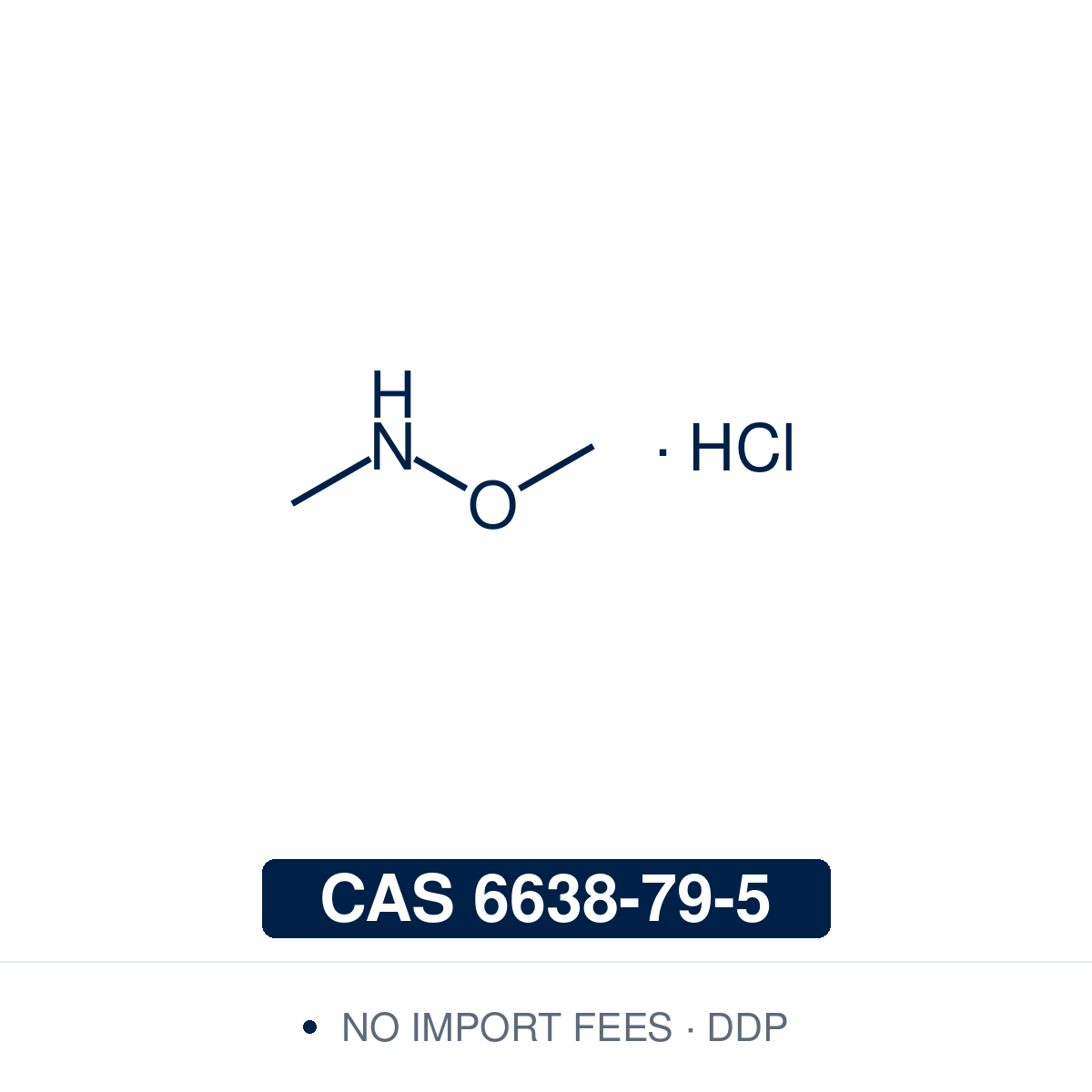
Weinreb's salt (N,O-dimethylhydroxylamine·HCl)
Weinreb's salt (N,O-dimethylhydroxylamine·HCl) | CAS 6638-79-5 | ≥98%
Couldn't load pickup availability
Technical Specifications
| CAS Number | 6638-79-5 |
| EC / EINECS Number | 229-642-1 |
| MDL Number | MFCD00012485 |
| SMILES | CNOC.Cl |
| InChI | InChI=1S/C2H7NO.ClH/c1-3-4-2;/h3H,1-2H3;1H |
| InChIKey | USZLCYNVCCDPLQ-UHFFFAOYSA-N |
| PubChem CID | 81138 |
| Molecular Formula | C₂H₈ClNO |
| Molecular Weight | 97.54 g/mol |
| Melting Point | 112-115 °C |
| Solubility | Soluble in water |
| Purity | ≥98% |
| Physical Form | White to almost white powder to crystal |
| HS Code | 2928.00 |
| Shelf Life | Retest period: 36 months from date of manufacture |
| Storage Conditions | Store in a cool, dry place in a tightly sealed container, protected from moisture and air. Hygroscopic. |
Product Description & Scientific Applications
N,O-Dimethylhydroxylamine hydrochloride is the salt from which N-methoxy-N-methylamides — Weinreb amides — are made, and its value in synthesis follows entirely from the behaviour of those amides. Coupling the free base, liberated from the hydrochloride, to a carboxylic acid derivative installs the N-methoxy-N-methyl group; the resulting Weinreb amide reacts with a single equivalent of an organometallic or hydride nucleophile and then stops. The methoxy oxygen and the carbonyl oxygen chelate the metal to form a stable five-membered tetrahedral intermediate that does not collapse until aqueous work-up, so the electrophilic carbonyl is masked during the reaction and over-addition is suppressed. This is the property that distinguishes the reagent: an ester or acid chloride treated with a Grignard or organolithium reagent tends to add twice and give a tertiary alcohol, whereas the corresponding Weinreb amide delivers the ketone cleanly at one addition.
Applications
The two classic transformations exploit that controlled single addition:
- Ketone synthesis — organolithium and Grignard reagents convert Weinreb amides to ketones, giving unsymmetrical ketones without the tertiary-alcohol by-product; the same chelation control underlies newer triazinylamide variants developed for sequential double substitution.
- Aldehyde synthesis — diisobutylaluminium hydride reduces Weinreb amides to aldehydes rather than over-reducing to the alcohol; where an α,β-unsaturated ester must be spared, it is protected in situ so that DIBAL-H reduces the α,β-unsaturated Weinreb amide to the α,β-unsaturated aldehyde and the ester is then recovered.
- Amide preparation — the amides are prepared directly from carboxylic acids by coupling the salt with reagents such as the triazine reagent DMT-MM, which furnishes Weinreb amides in high yields.
- C-Acylation and solid-phase synthesis — because the amide is a protected, non-over-adding acyl unit, it serves as a C-acylation reagent in natural-product total synthesis and, on solid support, lets a single resin-bound Weinreb amide precursor be released either as a C-terminal peptide aldehyde or as a hydroxamate.
Shipping Destinations
- EU & UK: Priority delivery, 2–5 business days.
- United States (DDP): 3–7 business days, duties and taxes prepaid.
- EFTA Countries (DDP): 3–7 business days, duties and taxes prepaid.
- Worldwide: 7–14 business days, selected locations.
Safety Information
| GHS Pictograms |

|
| Signal Word | Warning |
| Hazard Class | Not regulated for transport |
| Transport Category | Not classified as dangerous goods for transport (ADR/IATA/IMDG) |
| H-Statements | H315 - H319 - H335 |
| P-Statements | P261 - P264 - P271 - P280 - P302+P352 - P304+P340 - P305+P351+P338 - P312 - P321 - P332+P313 - P337+P313 - P362+P364 - P403+P233 - P405 - P501 |
Documentation
| Safety Data Sheet | Download PDF |