NorrChemica™
XPhos Pd G3
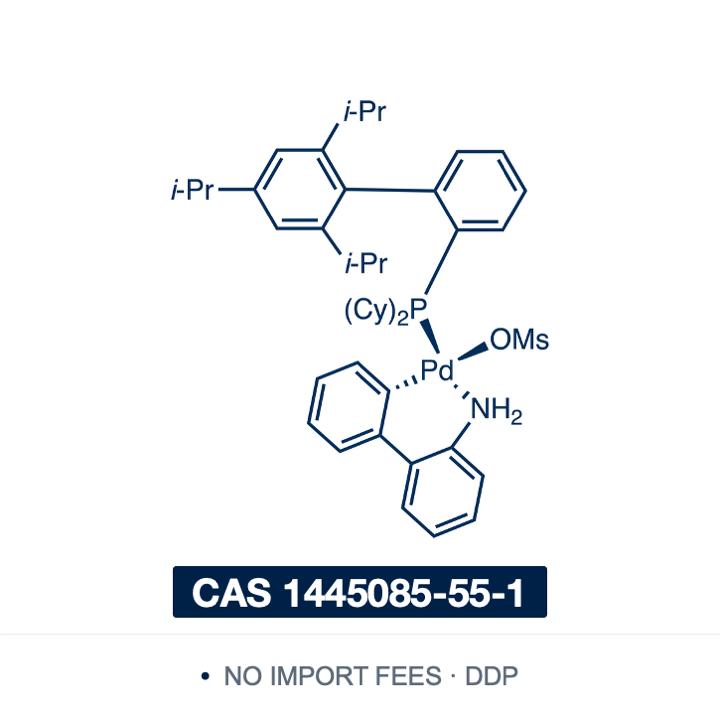
XPhos Pd G3 | CAS 1445085-55-1 | ≥98%
Couldn't load pickup availability
Technical Specifications
| CAS Number | 1445085-55-1 |
| EC / EINECS Number | 830-976-0 |
| MDL Number | MFCD22417234 |
| SMILES | CC(C)C1=CC(=C(C(=C1)C(C)C)C2=CC=CC=C2P(C3CCCCC3)C4CCCCC4)C(C)C.CS(=O)(=O)O.C1=CC=C([C-]=C1)C2=CC=CC=C2N.[Pd] |
| InChI | InChI=1S/C33H49P.C12H10N.CH4O3S.Pd/c1-23(2)26-21-30(24(3)4)33(31(22-26)25(5)6)29-19-13-14-20-32(29)34(27-15-9-7-10-16-27)28-17-11-8-12-18-28;13-12-9-5-4-8-11(12)10-6-2-1-3-7-10;1-5(2,3)4;/h13-14,19-25,27-28H,7-12,15-18H2,1-6H3;1-6,8-9H,13H2;1H3,(H,2,3,4);/q;-1;; |
| InChIKey | MSDBKVKSEKVUAJ-UHFFFAOYSA-N |
| PubChem CID | 117064974 |
| Molecular Formula | C₄₆H₆₃NO₃PPdS⁻ |
| Molecular Weight | 847.5 g/mol |
| Melting Point | 146–151 °C (dec.) |
| Solubility | Highly soluble in a wide variety of common organic solvents, except in hexanes and pentane. |
| Purity | ≥98% |
| Physical Form | White to off-white solid powder |
| HS Code | 2843.90 |
| Shelf Life | Retest period: 36 months from date of manufacture |
| Storage Conditions | Relatively stable in air for weighing and handling. Store refrigerated (2–8 °C) in a tightly closed container, protected from light and under inert gas (N₂ or Ar). |
| SDS / CoA | Download PDF |
Product Description & Scientific Applications
XPhos Pd G3 is the ready-to-use palladium form of XPhos: the ligand, a deprotonated 2-aminobiphenyl and a methanesulfonate on one palladium centre, giving a defined 1:1 ligand-to-palladium ratio in a single weighable solid. Base contact releases the monoligated palladium(0) active catalyst, so there is no separate reduction step and no phosphine-to-palladium ratio to optimise. It is air- and moisture-stable, works at low loading under mild conditions across a wide functional-group range, heterocycles included, and minimises batch and storage variation in the palladium source. This is the palladium complex and not the free ligand. XPhos alone is a separate product at 476.7 g/mol against 847.5 here, so a loading calculated from the ligand mass is out by nearly a factor of two.
Applications and Reactions
- Suzuki–Miyaura coupling. The dominant documented use. Aryl and heteroaryl iodides, bromides and chlorides run at 60 to 85% yields, on this precatalyst or one alternative. Tribasic potassium phosphate in 1,4-dioxane–water is the recurring set: (5-formyl-2-methylphenyl)boronic acid coupled at 90 °C in 80% yield, a related route running arylboronic acids at 100 °C in 60 to 66%. Caesium carbonate in 1,4-dioxane–water at 10 mol% carried a 5-methoxyindol-2-ylboronic acid onto a methylsulfonylpropanamide aniline. Away from aqueous mixtures, 3 mol% with caesium carbonate and ten equivalents of water in toluene at 100 °C ran in two hours; sodium ethoxide in ethanol served for 3-bromo-5-phenylpyridine with phenylboronic acid.
- Buchwald–Hartwig amination. With added XPhos it was the system examined across lipids as reaction solvents, yields rising from 75 to 100% in 1,1-diethoxyethane, 48 to 100% in toluene and 82 to 100% in nonane.
- Borylation. Tetrahydroxydiboron with potassium acetate in ethanol at 80 °C, then potassium carbonate in the same pot, gave 80%.
- Cyanation. With zinc cyanide, triethylamine both activates the precatalyst and solubilises the cyanide source, giving a modest yield.
Activation. Base contact drives reductive elimination of carbazole and leaves the monoligated palladium(0) that performs the catalysis; until that point the aminobiphenyl is monoanionic and bound through both carbon and nitrogen. Mass spectrometry has followed the conversion, precatalyst and palladium(0) signals falling as the oxidative addition complex appears.
Two isolable forms. In solution these precatalysts isomerise into two forms, distinguished by whether the mesylate or a carbon–carbon double bond occupies the palladium coordination sphere. Nuclear magnetic resonance is a rapid quality-control method for them.
Documented limits. In a copper-free Sonogashira protocol with caesium carbonate in acetonitrile it raised neither the yield nor the purity of the products. The source attributes the difficulty to a β-ketoamide that may be coordinating the metal.
Further reading: For phosphine-ligand selection, palladium sources and precatalysts, and Suzuki–Miyaura and Buchwald–Hartwig reagent choice, see NorrChemica's Lab Journal guide: Choosing a Phosphine Ligand for Cross-Coupling: A Practical Guide.
Shipping Destinations
- EU & UK: Priority delivery, 2–5 business days.
- United States (DDP): 3–7 business days, duties and taxes prepaid.
- EFTA Countries (DDP): 3–7 business days, duties and taxes prepaid.
- Worldwide: 7–14 business days, selected locations.
Safety Information
| GHS Pictograms |

|
| Signal Word | Warning |
| Hazard Class | Not regulated for transport |
| Transport Category | Not classified as dangerous goods for transport (ADR/IATA/IMDG) |
| H-Statements | H315 - H319 - H335 |
| P-Statements | P261 - P264 - P271 - P280 - P302+P352 - P304+P340 - P305+P351+P338 - P332+P317 - P337+P317 - P403+P233 - P405 - P501 |
Documentation
| Safety Data Sheet | Download PDF |